 Skip to content


UNWD Journal · Stress & the Nervous System
Stuck in fight-or-flight? Signs you can't switch off, and how to get out
By James, Founder

Quick answer: Being stuck in fight-or-flight means your body’s alarm stays on after the stress is over. You feel wired and tense, and you can’t settle, even when nothing is wrong. The way out is to send your body clear “you’re safe” signals: slow breathing with long breaths out, movement, cool water and a daily calming habit. After a single stressful moment, most people’s bodies settle in about 20 to 30 minutes.
Maybe you can’t switch off. Your shoulders live up by your ears. You feel “on” from the moment you wake up. If that’s you, this guide is for you.
What is fight-or-flight?
Fight-or-flight is your body’s automatic response to danger. It gets you ready to fight or run, in seconds.
Here’s how it starts. A small part of your brain called the amygdala spots a threat. Think of the amygdala as a smoke alarm. It goes off fast, even when it’s only burnt toast. It alerts another part of your brain, the hypothalamus, which works like a 911 dispatcher sending out the fire trucks. Next, your adrenal glands, two small glands on top of your kidneys, release adrenaline. Adrenaline is a fast stress hormone. Your heart speeds up. You breathe faster. Your body dumps sugar and fat into your blood for quick energy.
If the threat seems to keep going, a second system takes over. Doctors call it the HPA axis. It keeps you on alert with cortisol, a slower stress hormone. If adrenaline is a sprint, cortisol is a long jog that keeps you going for hours.
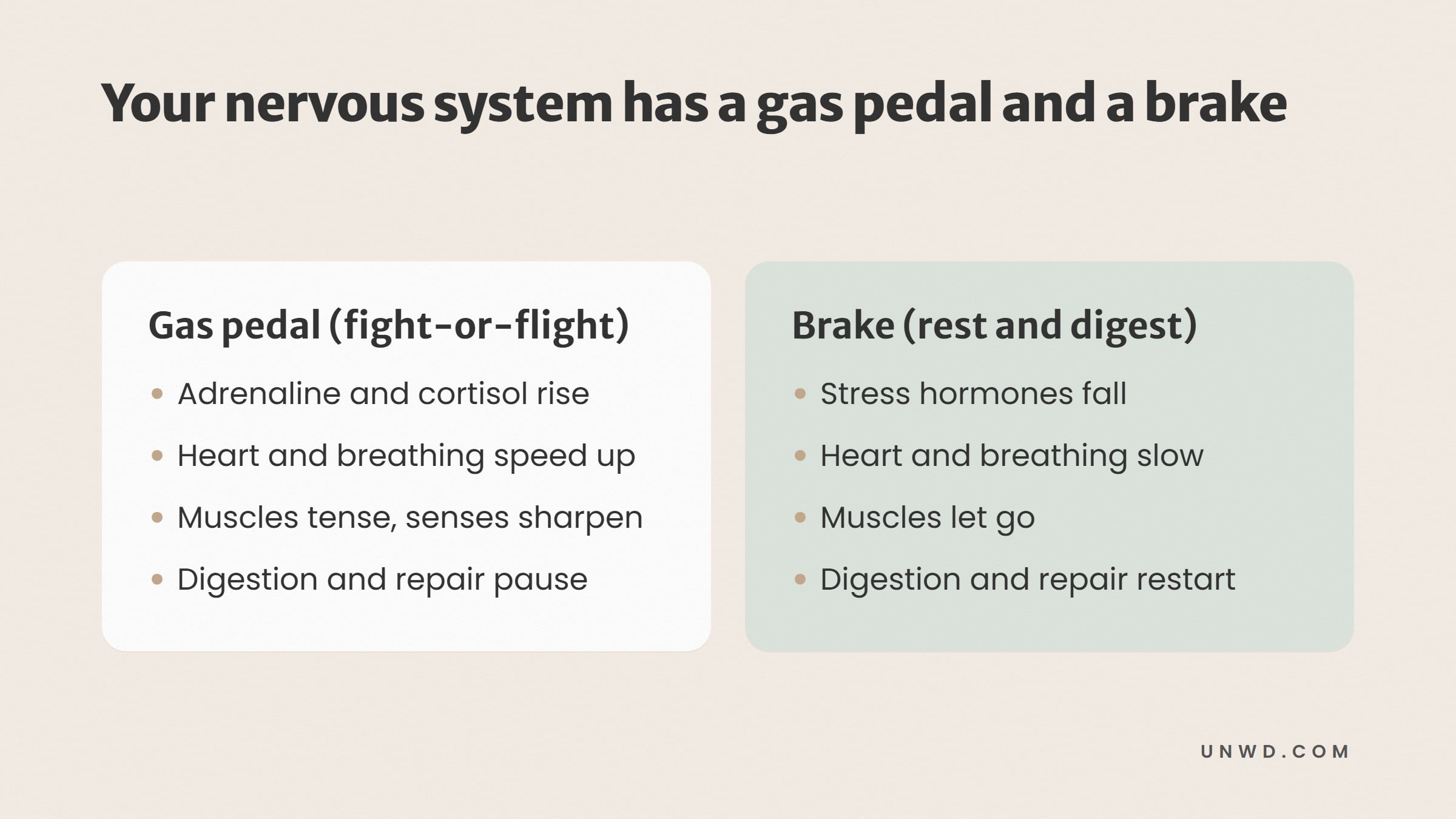
Harvard Health compares it to a car. Fight-or-flight is the gas pedal. The “rest and digest” side of your nervous system is the brake. It calms everything down once the danger is gone.
What are the signs you’re stuck in fight-or-flight?
The clearest sign is that your body stays on alert long after the stressful moment is over. Common signs include:
- You can’t switch off, even when you finally have time to rest
- Racing thoughts, especially at night or first thing in the morning
- A tight jaw, tense shoulders or a knot in your stomach
- Fast or shallow breathing without noticing it
- Jumping at small sounds
- Snapping at people you love over small things
- Feeling wired and tired at the same time
- Your stomach acting up when you’re stressed
Cleveland Clinic calls a stress response that turns on too easily, or stays on too long, hyperarousal. Hyperarousal means your alarm is set too sensitive, like a car alarm that goes off when a leaf lands on it. It’s not something to diagnose yourself. But noticing your own pattern is the first step to changing it.
Why does my body react like I’m in danger when I’m not?
Because your alarm can’t tell a real threat from a stressful day. Natacha Duke, a registered psychotherapist writing for Cleveland Clinic, says everyday things can set off the same response as real danger. Think of giving a presentation, a work deadline or a party.
One stressful moment is fine. Your body is built for it. The trouble starts when the triggers keep coming, like emails, money, family and the news, and the brake never gets a turn. Harvard Health notes that setting off the stress response again and again takes a toll on the body over time.
How long does fight-or-flight last?
After one stressful moment, your body usually takes about 20 to 30 minutes to calm down, says Cleveland Clinic. It’s different for each person and each trigger. But if you keep hitting new triggers, or keep replaying the first one in your head, the clock starts over. It’s like a kitchen timer that keeps getting reset before it reaches zero. That’s why it can feel like you’ve been “on” all day.
How do you get out of fight-or-flight mode?
You get out of fight-or-flight mode by showing your body you’re safe. Breathing, movement and temperature work fastest. They act on your body directly, so you don’t have to argue with your thoughts.
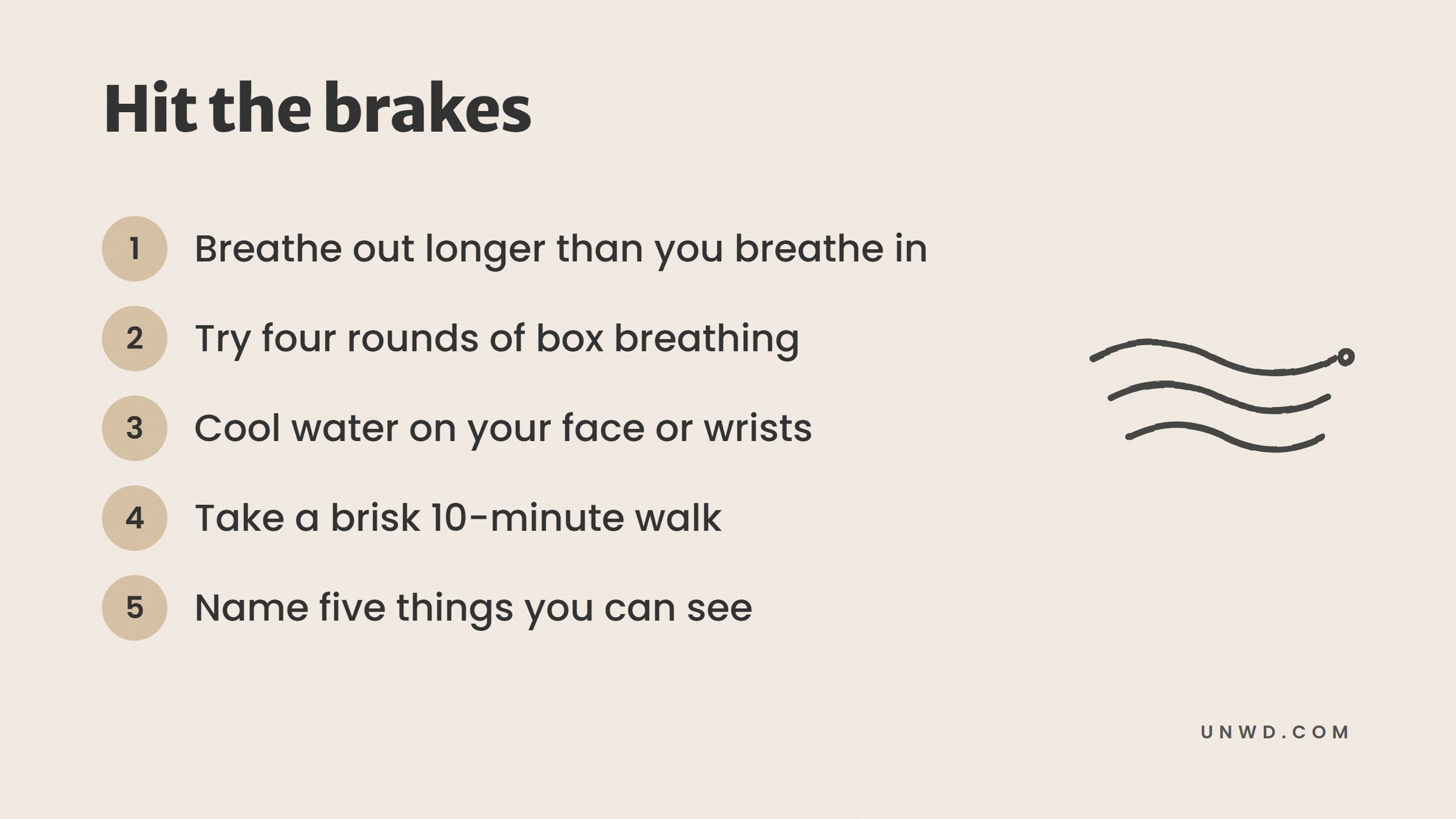
1. Breathe out longer than you breathe in
Slow, deep breaths from your belly are one of the best brakes you have. Breathe in through your nose for a count of four. Then breathe out slowly for a count of six. Keep going for a few minutes. The long breath out is the part that tells your body to slow down.
2. Try box breathing
Breathe in for four. Hold for four. Breathe out for four. Hold for four. Do this three or four times. Cleveland Clinic suggests this pattern because counting also gives a busy mind something simple to hold on to.
3. Use cool water
Splash cool water on your face. Or hold a cool cloth or an ice pack against your face, the back of your neck or the inside of your wrists. The quick change in temperature can help break the spiral.
4. Move for 10 minutes
Fight-or-flight gets your body ready to move, so let it move. Harvard Health says a brisk walk soon after a stressful moment can deepen your breathing and loosen tight muscles. It’s like letting steam out of a pot before it boils over.
5. Ground yourself in the room
Name five things you can see, four you can hear and three you can feel. This pulls your mind out of “what if” and back into the room you’re actually in.
6. Write down what sets you off
Keep a short note of your stress signs and what came right before them, like poor sleep, a tense call or a long day with no break. Spotting your pattern helps you step in earlier next time.
7. Talk to someone you trust
Call a friend or family member. It’s more than a distraction. Harvard Health points to close relationships as a buffer during long stretches of stress.
8. Practice when you’re calm, not only when you’re stressed
A few minutes of breathing, yoga or meditation on normal days trains your body to find the brake faster on hard days. Think of it like a fire drill. You practice when there’s no fire, so you know what to do when there is one. Harvard Health is honest that these practices help some people more than others and aren’t a cure-all. Most people need a few weeks of practice before they notice a change.
When should you talk to a professional?
Talk to your doctor or a licensed therapist if feeling on edge is your normal, if it’s hurting your sleep, work or relationships, or if nothing on this list helps. They can look at the whole picture and help you find what fits you.
What if you feel “on” every single day?
For many busy, driven people, being stuck in fight-or-flight doesn’t look like a crisis. It looks like a full calendar, a short fuse and a mind that never fully goes quiet. The tools above are the foundation. They work best as daily habits.
Some people also add Mind Hack® to their routine. It does one simple thing: help calm the mind. It’s one plant ingredient, one scoop a day, and most people take it in the morning. There’s no high and nothing sedating, so you can still think clearly at work. Most people notice it within one to two weeks. It isn’t for everyone, so it comes with a Calm Guarantee: feel the calm or your money back. Here’s how to take Mind Hack®, with short videos. Other questions are answered in our FAQ.
Sources
- Harvard Health Publishing: Understanding the stress response (reviewed by Howard E. LeWine, MD, 2024)
- Cleveland Clinic: What is the fight, flight, freeze or fawn response? (Natacha Duke, RP, 2024)
- Cleveland Clinic: Hyperarousal
- Cleveland Clinic: How box breathing can help you destress
Mind Hack® does one simple thing: help calm the mind.
One plant ingredient. No high. Feel the calm or your money back.
Frequently asked questions
Most people say they feel wired, tense and unable to switch off, even when nothing is wrong. Racing thoughts, a tight jaw or shoulders, shallow breathing and a short fuse are common signs.
After one stressful moment, the body usually settles in about 20 to 30 minutes. If new stress keeps coming, or you keep replaying the first one, it can feel like it never stops.
Body-based tools work fastest: slow breathing with a longer breath out, box breathing, cool water on your face or wrists, or a brisk walk.
Many people feel on edge for long stretches when stress keeps coming. If it has become your normal, it's worth talking to your doctor or a therapist about it.
No. Mind Hack® helps calm the mind without sedation and with no high, which is why most people take it in the morning.
*These statements have not been evaluated by the Food and Drug Administration. UNWD is a dietary supplement and is not intended to diagnose, treat, cure, or prevent any disease.


